|
 Search & Rescue Search & Rescue
When a hunter is missing or a hiker is lost, the ability to save a life is often dependent upon how quickly the person can be found and accessed. Ultra-sensitive hearing, night vision, endurance and keen sense of smell are traits that  make dogs trained in search and rescue such invaluable partners in the effort to locate missing persons. Because of their extraordinary abilities, dogs are often able to reduce the time spent searching, thereby increasing the chances that the missing person(s) will be found alive. A search dog's success stems from the fact that every human being has a smell undetectable by human beings, which is caused by the constant shedding of skin rafts and bacteria from the human body. A single dog team, experts have estimated, can be as effective as 20 or more trained human searchers in locating a missing person within a given period of time. make dogs trained in search and rescue such invaluable partners in the effort to locate missing persons. Because of their extraordinary abilities, dogs are often able to reduce the time spent searching, thereby increasing the chances that the missing person(s) will be found alive. A search dog's success stems from the fact that every human being has a smell undetectable by human beings, which is caused by the constant shedding of skin rafts and bacteria from the human body. A single dog team, experts have estimated, can be as effective as 20 or more trained human searchers in locating a missing person within a given period of time. |
 The Foundation The Foundation
Encouraging play drive makes a game of elementary training. [more]

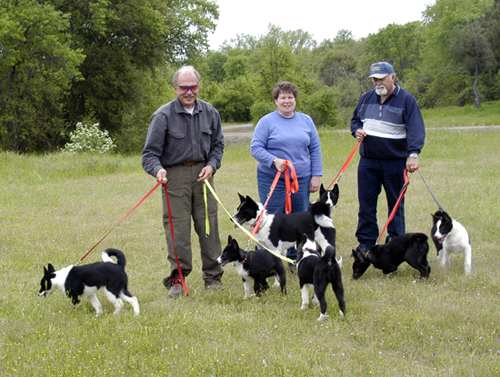
Next step: run away exercises, which resemble hide-and-seek, are great fun for any Karelian!

|
Formal Training

Qualifying a dog to be a search dog requires you, as the handler, to attain expert handling skills. You will be expected to maintain complete control of your dog in any environment under any weather conditions, night or day. To become "mission-ready", search dogs and their handers must generally pass a series of search tests in a variety of areas, which may include:
 Obedience: required exercises will need to be performed on and off leash. Obedience: required exercises will need to be performed on and off leash.
Agility: required skills will need to be demonstrated in an unfamiliar area.
Swimming: the handler must demonstrate the dog's ability to enter a body of water and swim a required distance.
Transport: the dog must be safely transported with other dog teams.
Sociability: the dog must behave appropriately around people and other animals.
Helicopter safety: the handler must safely load the dog on and off an operating helicopter with rotors in motion.
Night search training: the required number of activities must be conducted when it is dark enough to require the use of flashlights and in a location unknown to the handler. [more] |
Improving Your Handling Skills
 Training a dog on "mission ready" skills requires much of you as a handler. Whether or not your dog is ever called out on a search, teaching your dog even some of the skills required for SAR broadens your skills as a handler and improves your overall ability to communicate effectively with your canine companion. [more] Training a dog on "mission ready" skills requires much of you as a handler. Whether or not your dog is ever called out on a search, teaching your dog even some of the skills required for SAR broadens your skills as a handler and improves your overall ability to communicate effectively with your canine companion. [more]
Below, the ability to maintain physical control over your dog is essential to safely "hot loading" into a Black Hawk helicopter with rotors whirring overhead California Karelian's Star was just five months old when she participated in SAREX 2007 held in Yosemite, California. |
Getting Started in Search & Rescue
Participating in Search and Rescue training enables you to build relationships with other handlers and share knowledge and experiences. We very much enjoy counting Madde (below, middle) and Rob Watts, both of whom possess extensive backgrounds in search and rescue work, as friends of California Karelians. [more]
Madde and Rob produced and authored of Search Dog Training: How to Get Started and generously shared some basics with us that we now share with you. [more]
[back] |




