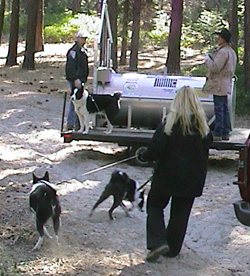
|

Large Predator Protection
Capitalizing on the Karelian Bear Dog's natural "hunting" instincts, these dogs are being used today in man's non-lethal response to predatory animals encroaching on "human territories." Where the objective is to promote peaceful co-existence, recreationalists and home owners who either enjoy outdoor activities or live in areas that border habitat inhabited by bears or mountain lions (also known as a cougar, panther or puma) are putting Karelian Bear Dogs to work.
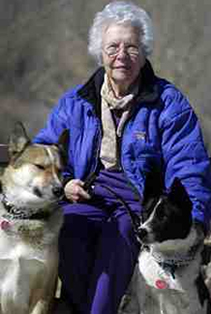 Well known for their ability to haze and chase bears, Karelians will alert on other intruders, both human and animal, in protection of their families. Well known for their ability to haze and chase bears, Karelians will alert on other intruders, both human and animal, in protection of their families.
Grammy, left, can personally attest to the Karelian Bear Dogs' effectiveness at home protection. House sitting for us, grammy heard our bear dogs alerting in the middle of the night. Once out of bed, she could hear unusual noices outside the house, and found our dogs immediately by her side. Their menacing barking and growling were more than enough to deter the would-be intruders. Grammy was shaken but, fortunately, unharmed.
Below left, California Karelians' Anya was introduced to the Lake Tahoe Sheriff's office when she was just a pup. Below right, now, when the Sheriff's office gets a bear call, Anya and her brother Dmytro assist the Tahoe BEAR League's Executive Director in getting the bear back into the forest. [more ] ] |
|
| |
Mountain Lions
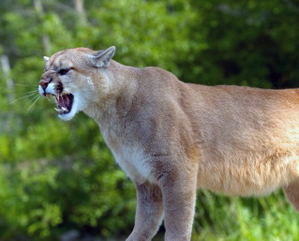 It may be a surprise to many southern California residents that in 2004 there were two documented mountain lion attacks, one of which was fatal, in Orange County, which is bordered on the west by the Pacific Ocean, on the north by Los Angeles County and on the south by San Diego County. California's Department of Fish and Game has been documenting verified mountain lion attacks on humans in California since 1890, many of them fatal. It may be a surprise to many southern California residents that in 2004 there were two documented mountain lion attacks, one of which was fatal, in Orange County, which is bordered on the west by the Pacific Ocean, on the north by Los Angeles County and on the south by San Diego County. California's Department of Fish and Game has been documenting verified mountain lion attacks on humans in California since 1890, many of them fatal.
With few natural enemies, the known range of mountain lions includes all of California. The growth of cities and the spread of human populations into mountain lion habitat brings people closer to these large cats.
[more] |
Living with California Black Bears
There are mountain communities in California no larger than 10 square miles that have bear dens within their city limits. Below, at an altitude of 8,000 feet, Mammoth Lakes is home to a concentration of black bears. Located in the Central Eastern Sierras, this region provides habitat for bears, mountain lions and coyotes.  Below, it is not unusual to spot bear tracks in the backyards of Mammoth Lakes residents. Local bears, having noticed that human food smelled good, abandoned digging for plant roots and began digging through garbage cans and dumpsters. They seemed to forget their natural fear of humans and began spending time in urban areas, where it was easy to find food. Trapping and moving the bears was unsuccessful. The bears simply came back. This community has a strong desire to co-exist with its black bear population, and a Karelian Bear Dog participates in the Mammoth Lake police department's bear deterrent efforts. The idea is to make it uncomfortable for the bears to be near humans and houses. Below, it is not unusual to spot bear tracks in the backyards of Mammoth Lakes residents. Local bears, having noticed that human food smelled good, abandoned digging for plant roots and began digging through garbage cans and dumpsters. They seemed to forget their natural fear of humans and began spending time in urban areas, where it was easy to find food. Trapping and moving the bears was unsuccessful. The bears simply came back. This community has a strong desire to co-exist with its black bear population, and a Karelian Bear Dog participates in the Mammoth Lake police department's bear deterrent efforts. The idea is to make it uncomfortable for the bears to be near humans and houses.
Black bears are distributed throughout much of North America. The California Department of Fish and Game reports that California's black bear population has increased over the past 25 years. Presently, the statewide black bear population is conservatively estimated to be between 25,000 and 30,000, up from about 15,000 in 1982. Black bears are believed to occupy 52,000 square miles in California. They can be found mostly in mountainous areas above 3,000 foot elevations.
Two subspecies of black bear are recognized in California, the northwestern black bear (Ursus americana altifrontalis) and the California black bear (U. a. californiensis). Distinguishing between distinct black bear "populations" is difficult in California, because there are no significant barriers restricting bear movement between occupied habitat. Black bears are large-bodied animals that have a small, narrow head, powerful limbs, and small ears. Black bears vary in color from tan or brown to black. Typically they are dark brown with a brown muzzle and, occasionally, a small white chest patch. Adult females weigh 100-200 pounds whereas adult males are larger, at 150-350 pounds. These bears have reached as much as 600 pounds in California, where the black bears have imaginitively learned to forage for food left accessible by humans.
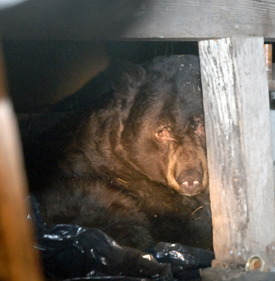
 Black bears are recognized as an important component of California's ecosystems and as a valuable resource for the people of California. Below, this picture taken by California Karelians in Mammoth Lakes shows that bears are remarkably comfortable living in close proximity to humans. This black bear is using a crawlspace under a building as a den. Plastic garbage bags and fast food containers littered the den. However, bear populations are generally densest in forested areas. [more] Black bears are recognized as an important component of California's ecosystems and as a valuable resource for the people of California. Below, this picture taken by California Karelians in Mammoth Lakes shows that bears are remarkably comfortable living in close proximity to humans. This black bear is using a crawlspace under a building as a den. Plastic garbage bags and fast food containers littered the den. However, bear populations are generally densest in forested areas. [more]
 In many locales, where the objective is to preserve bear populations, Karelian Bear Dogs are being "employed" by police departments and other public and private organizations where bears pose a threat to human safety. The Karelian bear dog will bark and chase the intruding bear, driving the predator back into the forest. In many locales, where the objective is to preserve bear populations, Karelian Bear Dogs are being "employed" by police departments and other public and private organizations where bears pose a threat to human safety. The Karelian bear dog will bark and chase the intruding bear, driving the predator back into the forest.
California Karelians donated two Karelian Bear dog puppies to Tahoe's BEAR League to assist with bear aversion. Ann Bryant, executive director, makes "bear calls" when residents need help coaxing a bear off their property. Ann took along Anya and Dmytro, her two California Karelians, on leash beginning at six months of age and started using them off leash at 11 months. [more]
The San Francisco Chronicle produced a slideshow featuring Ann and her two California Karelians at work. The slideshow is accessible by clicking more at the end of this paragraph and selecting the top left icon on the Chronicle page, where it says "listen." The slideshow downloads automatically. To play, click on the play button in the lower left of the video screen. [more] |
Grizzly Bears in the United States
The grizzly bear (Ursus arctos horribilis) is a subspecies of the brown bear. In the United States, grizzlies are found in Alaska, Idaho, Montana, Washington, and Wyoming. Available evidence suggests that fewer than 1,100 grizzly bears can be found in the continental United States.
Grizzlies are highly adaptable to various habitat types: they can flourish in forests, mountains, prairies, wetlands, and even along the shore. They will dig beds in shady spots in which to sit out the heat of the day. They hibernate in the winter when food is scarce, living off stored body fat, which not only supplies energy but also keeps them warm.
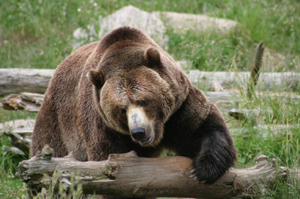 It isn't always easy to distinguish a grizzly bear from a brown or black bear (it's better to check the ears, which on a grizzly are round and smaller). A grizzly's coat can be any shade from black to blond, though it's usually brown. The name "grizzly" was inspired by light tips on the fur of the bear's head and shoulders. Grizzlies are heavier than black bears, though: the males average 500 lbs; and the females average 375 lbs. When on all fours, grizzlies stand between 3.5 and 4 feet; when standing upright, they reach 6 to 7 feet. It isn't always easy to distinguish a grizzly bear from a brown or black bear (it's better to check the ears, which on a grizzly are round and smaller). A grizzly's coat can be any shade from black to blond, though it's usually brown. The name "grizzly" was inspired by light tips on the fur of the bear's head and shoulders. Grizzlies are heavier than black bears, though: the males average 500 lbs; and the females average 375 lbs. When on all fours, grizzlies stand between 3.5 and 4 feet; when standing upright, they reach 6 to 7 feet.
Cubs, who weigh about a pound at birth, stay with their mothers for about two and a half years, during which time they are carefully protected. Usually in litters of two or three, the cubs will follow their mother, learning what to eat and where to find it. If danger approaches, it isn't uncommon for a mother bear to shoo her cubs up a tree for protection. Once the cubs have matured, they leave their mother to fend for themselves. With a span of approximately three years between litters, grizzlies are considered among the slowest reproducing mammals in North America. In the wild, grizzlies live 20 to 30 years.
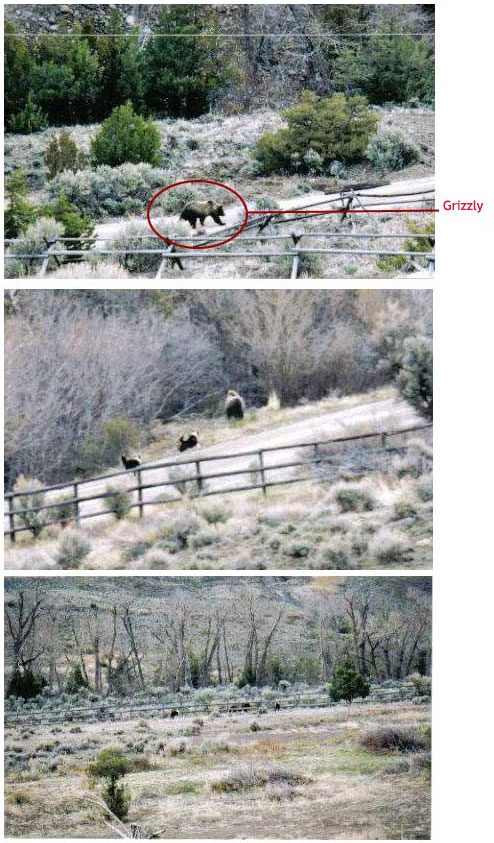
Long-term viability can only be achieved if there are enough animals and sufficient secure and productive habitat to ensure that the current population can survive for the indefinite future. Below, Karelian bear dogs are an effective non-lethal response to grizzlies who threaten human safety. With their courage to face large predators, they are agile enough to avoid the lethal swipe of a grizzly bear's paw. These pictures were taken in Wyoming. |
|
|
|
|