|

The Karelian Bear Dog Breed
Karelian Bear Dogs (KBDs) are a primitive dog that for millennia survived the harsh continental climate of the taiga zone of northeastern Europe, just below the tundra. Centuries ago, primitive hunting dogs made man's survival possible, providing meat for their families and pelts that could be traded for essentials such as flour, gun powder, and tea. In appearance, Karelian Bear Dogs exhibit traits of the native dogs of Finland, Karelia and northeastern part of European Russia. Karelia, after whom the dogs are named, is the land of the Karelian people, a vast area in northern Europe of historical significance for Finland, Russia and Sweden.
KBDs are descendents of the ancient spitz-type hunting dogs. The Finnish breeding of local native dogs to a standard began in 1936, and in 1946, the Karelian Bear Dog breed became recognized by Scandinavian and Finnish kennel clubs. Today, the Karelian Bear Dog is among the top ten most common dog breeds in Finland. The Finnish standard calls for a black dog with white markings on the head, chest, legs and abdomen. In 1946, the Karelian Bear Dog breed (called Bjornhund in Swedish or Karjalankarhukoira in Finnish) became recognized by Scandinavian and Finnish kennel clubs, and today the KBD is among the top ten most common dog breeds in Finland.
Karelian Bear Dogs were imported relatively recently to the United States and Canada. Most of the Karelian Bear Dogs bred in the United States are descendents from the KBDs and RELs that were brought to this country around 1991 by Dr. Shushanov. Names of his dogs can be found in pedigrees of many lines of KBDs now living in the United States. The Karelian Bear Dog was recognized by the United Kennel Club (UKC) in 1996, and offspring from Dr. Shushanov's breedings were registered with the United Kennel Club as KBDs.
Appearance
The Karelian Bear Dog (or KBD) is an extremely attractive medium-sized dog. The Karelian Bear Dog is considered a member of the spitz family of dogs,  which refers to dogs generally characterized by: long, thick fur; pointed ears and muzzle; and a tail that is curled over the dog's back. which refers to dogs generally characterized by: long, thick fur; pointed ears and muzzle; and a tail that is curled over the dog's back.
At the withers, Karelian Bear Dog males are 21 to 23-1/2 inches and the females 19 to 21 inches. Karelian Bear Dogs look like a typical Nordic Spitz, with small prick ears and a tail that curls over the back. The ears are cocked and point outward slightly. They are lined with dense fur reducing the risk of frost bite. The head is wedge-shaped with a broad backskull. The short-haired all-weather coat consists of straight, stiff hair while the under-layer is soft and dense. The thighs are covered in thick hair. The KBD has a wide chest and is moderately angular in the rear. Today's breed standard calls for a black-and-white dog whose white markings are found in varying amounts on the head, neck, chest, abdomen and legs. A copper tint is common. Black speckles in the white are considered a fault. The nose is black, and the small dark eyes are very expressive. The tail is long and curls over the back in a typically Spitz arch. Robustly built, well-boned and of moderate size, the Karelian Bear Dog is slightly longer than he is tall. The body is sturdy and the back is well developed.
[more ] ] |
 Keen Hunting Instincts Come Naturally Keen Hunting Instincts Come Naturally
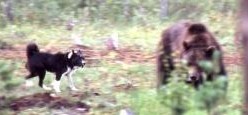
The Karelian Bear Dog that survives today is believed to have been one of the spitz-type hunting dogs of old. Right, coveted for its hunting abilities, the Karelian Bear Dog possesses unyielding bravery and determination, fearless by nature, unyielding of an oncoming threat. The Karelian Bear Dog was historically used mainly for hunting small fur-bearing animals, such as squirrels and marten. Like the Norwegian Elkhound, the Karelian Bear Dog was also used in hunting moose, lynx, wolf and, as its name would suggest, hunting the Eurasian brown bear (a bear species as large and aggressive as the American Grizzly). Traditionally, common types of working trials for the Karelian Bear Dog have included moose hunting trials, bear hunting trials and bear instinct trials.
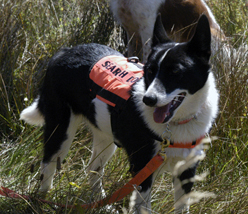
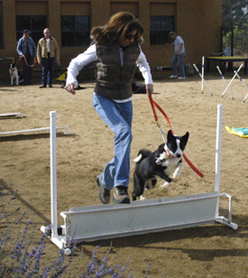
At California Karelians, we are showing that the confidence, drive and intelligence that distinguish this breed can be directed in other ways, including agility (right, with four-month old Polina), search and rescue (below, with eight-month old Kandy) and avalanche rescue. [more] |
|
|
 Family Companion Dogs Family Companion Dogs
As remarkable as the KBD's instincts for protecting and hunting is their capacity to make wonderful companion and family dogs. Starting at just a few weeks of age, it is clear that the Karelian Bear Dog is a discerning dog, not immediately friendly with strangers. Yet, Karelians are instinctively gentle with children and will bond remarkably quickly to a new owner. Right, California Karelian's Laska is anxiously awaiting a pet from children she met at Starbuck's. [more]
Throughout history Karelian Bear Dogs were the dogs of peasants and hunters who did not tolerate dogs attacking farm animals. Therefore, these dogs easily learn to leave domesticated animals alone.
A KBD will alert at the appearance of predators, making them a welcome companion on hikes and fishing or camping trips. Below, California Karelians' Shasta at six months old goes fly fishing on the Yellowstone River.

We at California Karelians live with KBDs indoors and out. This breed does need exercise and time to freely interact with its surroundings to stay healthy mentally and physically. Yet our Karelians are as eager to be with us as our Border Collie, enjoying opportunities to follow us around the house or lie next to us when relaxing in the evening.
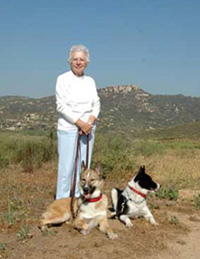
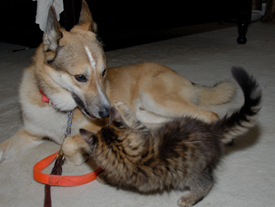
Below left, California Karelians are raised with Maine Coon cats and we intentionally enourage our kittens and Karelians to interact at a young age as part of our kitten socialization process. Below right, California Karelians' Shasta meets the other canine members of her family. [more] |
 |
 |
 The Role of Obedience Training The Role of Obedience Training
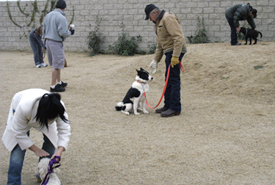
At California Karelians, puppy obedience training includes participating in group training classes where the puppy practices obeying even with the distraction of other dogs. Such early experiences also help socialize the puppy. Right, California Karelians' five-month-old Dozor is participating in Beginning Obedience taught by John Rubin of JohnKnowsDogs.com to both reinforce the early training Dozor received at home with us and socialize him to other dogs. [more]
Karelian Bear Dogs do well with an experienced handler, but because of their intelligence and quickness, we do not recommend them as a first dog. As with any breed, obedience training should be started early to help ensure the dog's safety and your enjoyment of this remarkable breed.
Faithful Protectors
Karelian Bear Dogs are known for their devotion to their masters and will fearlessly protect their home and family. Below right, we brought California Karelians' Snowflake along to a kitten wellness visit with our vet, and he made certain the health professionals took good care of his kitten. Our KBDs thankfully prevented a home invasion while we were out of town, and Grammy (below right) was home alone. |
|
|
Because of their discerning nature, Karlian Bear Dogs are generally guarded in public. You can expect a Karelian Bear Dog to announce all visitors, welcome or unwelcome. This innate quality makes the KBD a consistent protection dog, especially well-suited companions for those individuals living, working, or spending time in areas that are known to have high concentrations of bear or other predatory animals.
 At Yosemite, Mammoth Lakes, Glacier National Parks and in Alaska, where large predators pose a threat to human safety yet the objective is to preserve bear and other wildlife populations, KBDs are being effectively used by private citizens, police departments At Yosemite, Mammoth Lakes, Glacier National Parks and in Alaska, where large predators pose a threat to human safety yet the objective is to preserve bear and other wildlife populations, KBDs are being effectively used by private citizens, police departments 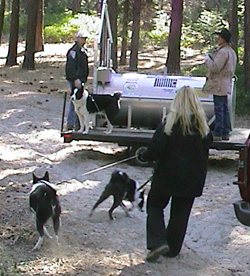 and other organizations. Search and Rescue professionals have characterized the Karelian "as the only suitable dog for backcountry work, where the landscape is frequented by bear, and cougars." [more] and other organizations. Search and Rescue professionals have characterized the Karelian "as the only suitable dog for backcountry work, where the landscape is frequented by bear, and cougars." [more]
Right, California Karelians' Anya and Demitri, (owned by Ann Bryant, executive director of the Lake Tahoe BEAR League) are assisting the Nevada Department of Wildlife in releasing a bear. [more]
We encourage you to consider for yourself whether this breed of dog will be suitable for your household. We are happy to discuss your aspirations for owning one of these wonderful dogs; feel free to contact us at info@karelianbeardog.us.
To learn more about some of our cat and dog adventures, you can also visit our blog. [more] |
|
|