
Centuries and centuries ago, aboriginal (native) dogs of similar type were originally distributed over a vast area in the taiga forest zone of northeastern Europe that included Karelia, the territory after which the Karelian Bear Dog is named. Today, Karelia straddles the present-day border between Finland and Russia. To understand the origins of the Karelian Bear Dog, it helps to understand the political history of the peoples who once inhabited Finland and the territory eastward, including Karelia.
The Karelian People
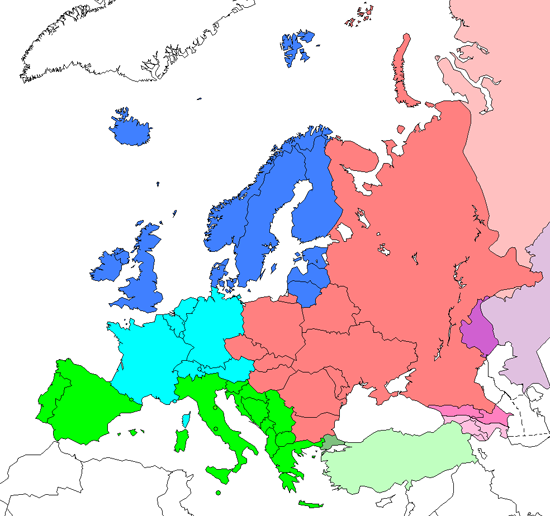
Below, while the boundaries of Eastern Europe are the subject of varying perspectives, generally the dark blue represents Northern Europe; the light blue, Western Europe; the bright green, Southern Europe; and the red, Eastern Europe.
 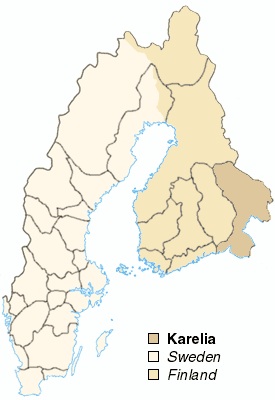
Right, Karelia is a territory that straddles the present-day border between Finland and Russia. To understand the origins of the Karelian Bear Dog and their relationship to their close relative, the Laika, one needs to understand how the peoples of Karelia became divided as ownership of this border area fluctuted back and forth between two neighbors, Finland and Russia.
Through the beginning of the ninth century, the Karelian people were one of the established tribes of Finland. Karelians lived scattered across a broad area, stretching from the southeast corner of present-day Finland eastwards to the Karelian isthmus, and in the north from the northern edge of Lake Ladoga to Lake Onega and on to the shores of the White Sea.
But by the 13th century, Sweden and Russia's Novgorod Republic were bitterly fighting over Karelia. In 1323, the Treaty of Nöteborg divided Karelia between Sweden and Novgorod Russia, but the Treaty did not end the strife. Over the succeeding centuries, the political border shifted no fewer than nine times.
In 1808, Sweden and Russia went to war in what would be called the Finnish War. The Russians prevailed in 1809, and Sweden ceded the eastern third of Sweden. The semi-autonomous state, the Grand Duchy of Finland, was created. Finnish independence occurred in 1917, and the border between the newly independent Finland and Soviet Russia was confirmed for the first time in the Peace of Tartu in 1920.
Karelia experienced rapid industrialization, but hostilities did not cease until two more wars were fought, now between Finland and the Soviet Union. The Winter War (1939-1940) and the Continuation War (1941-1944) established a new frontier between Finland and the Soviet Union that was officially confirmed in the 1947 Treaty of Paris.
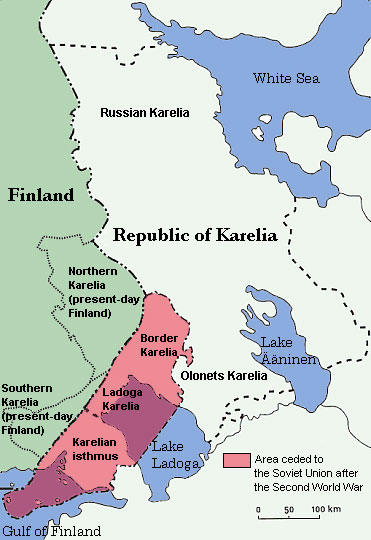 Now, with the return of peace, the territory known as Karelia was officially split in two, between a Finnish Karelia and a Russian Karelia. Yet for centuries before, the people of Karelia had split into two related but different ethnic groups. Karelians were two distinct peoples, visible across language, culture, and religion -- Orthodox in the east and Lutheran in the west.
East Karelia (or Russian Karelia) had predominately remained under Russian supremacy. It was separated from the western part of Karelia, which had been Swedish Karelia before 1808 and then Finnish Karelia.
[more] [back] Now, with the return of peace, the territory known as Karelia was officially split in two, between a Finnish Karelia and a Russian Karelia. Yet for centuries before, the people of Karelia had split into two related but different ethnic groups. Karelians were two distinct peoples, visible across language, culture, and religion -- Orthodox in the east and Lutheran in the west.
East Karelia (or Russian Karelia) had predominately remained under Russian supremacy. It was separated from the western part of Karelia, which had been Swedish Karelia before 1808 and then Finnish Karelia.
[more] [back]
|
