|

Our Training Values
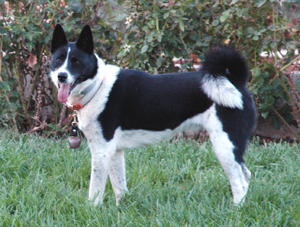 By Bill Bates and Bill Fantozzi By Bill Bates and Bill Fantozzi
For generations, man has bred dogs to perpetuate certain characteristics, such as temperament, size, color, hair length, agility, and stamina. Currently, the American Kennel Club (AKC) recognizes more than one hundred breeds of dog, which are further broken down and classified into six major groups, including the Sporting Group, Working Group, and Hound Group. Other countries such as Canada, England, Mexico and Finland have their own registries.
An accepted standard exists to describe the qualities that define each breed of dog. This accepted standard will tell you what dogs of that breed should look like in specific detail. For example, the AKC book of Dog Standards might read:
NOSE- large, black, broad bridge
CHEST- broad, deep, well defined
FORELEGS- straight, strong, parallel.
 While most people can describe with specificity what a particular breed should look like, they become rather general when discussing temperament and ability. Indeed, within each breed, there are certain lineages (blood lines or genetics) that have stronger instincts than others. In reality, not all water dogs like to swim, not all retrievers will retrieve, not all pointers point and not all German Sheppard’s make good police dogs. Moreover, each animal has his/her own personality and temperament within the broad description of temperament that is generally accepted for the breed. While most people can describe with specificity what a particular breed should look like, they become rather general when discussing temperament and ability. Indeed, within each breed, there are certain lineages (blood lines or genetics) that have stronger instincts than others. In reality, not all water dogs like to swim, not all retrievers will retrieve, not all pointers point and not all German Sheppard’s make good police dogs. Moreover, each animal has his/her own personality and temperament within the broad description of temperament that is generally accepted for the breed.
It is in respect of these individual variations that our training philosophy at California Karelians departs from more common training approaches. We believe that a good trainer will recognize and capitalize on the natural instincts that each individual dogs possesses. |
Just as no two dogs will respond exactly alike to the same training technique, setting a rigid expectation as to what will be accomplished in a single training session is ill advised. Even dogs can have a "bad" day. The key is to train the dog based on how the dog responds in each particular training session. If you need to go back and reinforce something the dog appeared to have "mastered," don't get discouraged. Understanding and patience are as important as consistency and good training technique. Training should be enjoyable for both you and your dog. While not all inclusive, the following principles reflect the way we relate to, and train, California Karelians:
 We strive to be conscious of each dog’s individual personality and temperament and are sensitive to how he/she responds to correction. We apply methods of correction that are best suited to the personality and age of each dog. We strive to be conscious of each dog’s individual personality and temperament and are sensitive to how he/she responds to correction. We apply methods of correction that are best suited to the personality and age of each dog.
We pay particular attention to each dog’s body language. The mere look in the dog's eyes can tell you what it is thinking or feeling.
We make certain our dogs understand what behavior we expect by maintaining a steady delivery of training iterations, gradually increasing the difficulty. When the dog demonstrates that it understands what is being asked, and only then, we add new challenges.
We never rush, or are impatient about, our training goals. Blind determination to accomplish a specific goal in a specific training session without considering the dog's reaction is the single biggest mistake that a novice owner/handler can make.
We treat our dogs as long-term companions and value the joy that they bring to our lives. Through our training program, we strive to develop the innate capabilities that Mother Nature has given these truly remarkable dogs.
|
 |
 |
Correcting your dog
To make sure the dog knows WHY it is being corrected, apply the correction IMMEDIATELY after the behavior you are trying to modify (break). Corrections applied even minutes after the behavior do not work.
An example: You come home to find your favorite rose bush dug up. You call your dog, it comes to you, and you apply a correction. In the dog’s mind it is being corrected for coming to you.
There is no optimal amount of force to be used when applying a correction. Know your dog. Just as each breed of dog is different, dogs within each breed have individual personalities. As a result, different dogs will respond differently to the type of correction and the force used to deliver the correction. Your dog's body language will tell you as much as if it could speak. A correction should never be applied with the intention of causing pain, yet it is important to apply sufficient negative stimulus that the dog will choose to modify its behavior in the future. Being too permissive with your dog can be deadly for your dog. If you cannot consistently recall your dog by calling one time, it is not safe for your dog to be off its leash. [more ] ] |
 Bill Bates: Training Adviser for California Karelians Bill Bates: Training Adviser for California Karelians
Bill Bates has been associated with the dog world since he was old enough to walk. His parents raised Cocker Spaniels for show, and Bill spent many weekends at various dog shows in the Chicago area. As he got big enough to hold on to the end of a leash, he used to exercise dogs for owners at these shows.
As a young adult, Bill purchased his first dog, a Labrador Retriever. Realizing the dog needed training, he enrolled in a local obedience class. This experience opened a whole new world for him. Bill became an assistant to the instructor, helping him with problem dogs in class. He even filled in for the instructor from time to time.
Eventually Bill opened his own training facility, providing class, semi-private, and private training in the three levels of obedience recognized by the American Kennel Club, Companion Dog, Companion Dog Excellent and Utility. He also had a limited kennel facility where he would board and train dogs in obedience and field for their owners. He began breeding Labrador Retrievers, taking his dogs to their obedience degrees as well as their bench championships. Bill devoted many weekends judging obedience classes for various club matches in the San Diego and Los Angeles areas. Bill then started training his Labradors in field work, and their success led to him to expand his training to include field work for Retrievers, Pointers and flushing Spaniels.
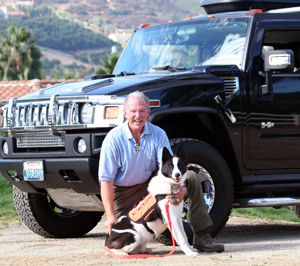
 Bill brings over 20 years of experience training roughly 50 different breeds of dogs in obedience and/or field work. Currently he is working exclusively with California Karelians Kennel. Left, Bill is traveling to a training exercise with one of our puppies. [more] [back] [more on Obedience ] Bill brings over 20 years of experience training roughly 50 different breeds of dogs in obedience and/or field work. Currently he is working exclusively with California Karelians Kennel. Left, Bill is traveling to a training exercise with one of our puppies. [more] [back] [more on Obedience ] |
|
|

