|

 Traveling With Your Karelian Traveling With Your Karelian
Karelian Bear Dogs enjoy staying close to their owners and make excellent travel companions. Right, it is a treat to travel with California Karelians' Grammy. Here, puppy Star and adult Laska (look closely in the upper left) pile into the car.
Safeguarding your traveling Bear Dog is not so different from how you would safeguard a child. Instead of a car seat, we recommend a plastic kennel in case of suddent stops. If temperatures permit, your Karelian can be left unattended to guard the car; if your dog has not outgrown the chewing stage, just be sure you protect anything you don't want the dog to gnaw.
Below, Laska is protecting the Hummer awaiting our return. It is difficult to see in the photo, but we do have Laska on a leash. We recommend a metal chain if your dog is young enough to still chew things.
 Special Tips for Puppies Special Tips for Puppies
If you anticipate traveling with a puppy who hasn't much experience with traveling, it is very helpful to prepare your puppy for the feel of a car ride. Load a comfortably sized plastic carrier in your car and drive the puppy short distances at first, such as around the block. Gradually increase the duration and practice stopping for a potty break.
Once you are traveling, it is far better to let the puppy "have an accident" in the carrier than stop in an unsafe place to walk the puppy (like the side of a freeway). Do NOT scold the puppy for doing what was necessary, and do NOT make the clean up a traumatic event. "Hosing the puppy down" will seriously scare a puppy and not promote bonding and trust between you and your puppy. Use a few wet cloths if the faucet on your sink isn't flexible enough, and BE GENTLE as you talk nicely to the puppy. Clean up will be easier if you do not make it unpleasant for the puppy. |
Cross Country Trips
We have all gone on outings, whether it be a two-week vacation, a weekend in the mountains, or just a quick one-day adventure. What many folks neglect to consider is, What happens if a natural or man-made incident, such as an earthquake, snowstorm, flood or road closure, prevents us from getting home as scheduled? We usually can take care of ourselves, but what about our furry friend in the back seat?
I recommend that you carry in your car a food bowl, water bowl, and at least two gallons of water from your home water source. I have found that some dogs will not drink water to which they are unaccustomed. Carry enough of the dog's regulary food to last several more days than you plan to be gone, and don’t forget to bring utensils to open the cans and mix the food.
Dog Gear
Want your dog to be as prepared as you are for outdoor activities? There is lots of fun dog gear available so that your Karelian can participate in almost any outdoor activity. Check out Ruffwear for travel dog beds (we like the Mt. Bachelor dog bed) and food bowls. For the more ambitious humans, you'll also find boots, packs and life jackets for your Karelian. REI is another popular source for dog gear..jpg)
RIght, our preference for dog collars are Reflective Big Wolf collars from Pet EKcessories, although we find their matching leash to be too light weight. |
 First Aid First Aid
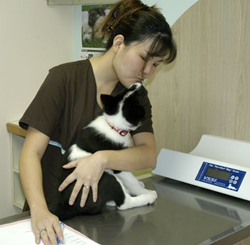
Check with your veterinarian for the proper eyewash and eardrops, which usually come in squeeze bottles. I recommend that you have one bottle of each with you. While speaking with your vet, please insure your dog is current on all vaccinations before leaving home.
If your travels include hiking in the mountains or woods with your dog, I recommend that you add an astringent cleaner and rolls of gauze and Vetrap bandaging tape to handle minor cuts or wounds. The Vetrap can be purchased at most pet or feed stores. When using Vetrap, be careful not to wrap so tightly as to impair circulation. Your vet can demonstrate the proper method of wrapping. |
 Air Travel Air Travel
It has been our experience that airlines do a great job ensuring that our California Karelians travel safely and comfortably. We have had airport security and airline crew members take a very special interest in our traveling California Karelians. Right, our puppies (not surprisingly) receive extra attention.
Kennel size is not only important, it is the law. Your dog has to able to stand up and turn around comfortably in the travel crate. A leash should be taped to the top of the kennel, just in case the dog needs to be moved out of the crate. The dog should always travel with a flat collar, never a prong collar.
Even on a short flight, food can be taped to the top of the crate, which is especially handy should there be a delay in the travel schedule. Clip a water bowl on the inside of the crate's door. Water will be added to the bowl by the airline crew. Anything else that needs to travel with the dog can be taped to the top of the crate.
Below, California Karelian's Laska participated in a photo shoot commissioned by Doctors Foster and Smith to demonstrate dog safety for air travel. |
 |
 |
 |
 |
 Winter Travel Winter Travel
In addition to the travel hints above, winter outings require additional planning. To help prevent heat loss, use kennels for transport that are enclosed. Consider using blankets for the animal inside the kennel, underneath the kennel, and on top of the kennel for extra warmth. Bringing along at least one highly absorbant towel is also a good safety precaution, in case your dog gets wet. These items carry easily in a medium size duffel bag for easy handling and storage if you even suspect that the weather may turn cold unexpectedly. Before starting out, learn how to recognize frost bite by consulting a first aid manual or asking your vet.
Even if your dog is acclimated to a northern climate, snow slides, highway closures or car problems can unexpectedly lengthen your trip. Carrying extra food and fresh water is a safety must for both you and your dog. Bringing an anti-diarrheal medication for your dog can also make the trip more pleasant, just in case.
For working dogs who will be expending extra energy, the morning meal should be lighter than the evening meal. Adding hot broth to each meal is also a good tip. You may also want to consider supplementing the dog's normal diet with higher calorie foods. Nutri-Cal, for example is a high calorie, palatable dietary supplement available on line
at petvetdirect.com. Because adequate hydration is also important, you may want to research some of the electrolyte supplements now formulated for dogs.
As you plan the trip, make sure you and your dog are given adequate time to acclimate to large shifts in temperature and elevation. We hope all your trips will be enjoyable and safe for all. [back] |
|
|

