| A Close Relative: The Russo-European Laika (REL)
 Since very old times and until early 20th century, medium size compact-built Laikas with pointed muzzle and prick ears were widely distributed across the taiga forest zone of northeastern Europe from Finland and Karelia to Uralian Mountains. Originally, they had several different coat colors -- black and white, wolf gray, red, black and tan, white and any color with white patches -- until black and white dogs became favored. These dogs were used mainly for hunting all kinds of game and as watchdogs. Since very old times and until early 20th century, medium size compact-built Laikas with pointed muzzle and prick ears were widely distributed across the taiga forest zone of northeastern Europe from Finland and Karelia to Uralian Mountains. Originally, they had several different coat colors -- black and white, wolf gray, red, black and tan, white and any color with white patches -- until black and white dogs became favored. These dogs were used mainly for hunting all kinds of game and as watchdogs.
Medium size, prick-eared Laikas remained favorite hunting dogs of peoples living on the fringes of European part of Russia, mainly in the taiga zone of northeastern Europe. However, not all of these Laikas were used for hunting. Many of them were simply watchdogs of peasants, living their entire life running loose near the house or behind the fence on the backyard.
Around the early part of the 20th century, Russian hunters living in and near big cities (especially Moscow and Leningrad), well aware of the outstanding hunting qualities of the aboriginal Laikas of northeastern Europe, bred them systematically close to the aboriginal type. Although dogs of certain geographic regions differed in muzzle length, ear size, body length and coat thickness and color, general similarities of these medium size Laikas are still well recognizable among local peoples living in Russian villages even today.
By 1960, the Russo-European Laika became established as a purebred.
Coats
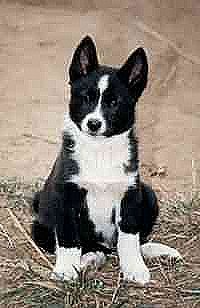
(Seven week old puppy, right) The coat color is black with white patches of variable size ranging from entirely black to entirely white. Gray color ticking on the head and dense ticking on legs of same color as body are deficiencies. Red color ticking on the body, head and legs and brown brindle colors are faults. The standard does not specify the shade of the black coat color. Actually, glossy and matte black dogs can be found. The coats of many black dogs living outside become bleached by the sun and obtain a brownish shade.
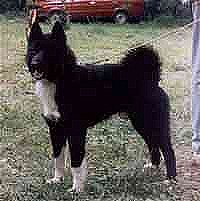 Guard hairs are straight, harsh and well developed; the undercoat is soft and dense. Hair is short on the muzzle, head and ears. On the neck, shoulders and around the face, guard hairs are longer, grow off the body and form a ruff and frame the head, especially in males. Leg hairs are stiff, short and close on the posterior sides of the front legs; the hind leg and thigh hairs are longer on the britches, but without feathering. On the feet, the hairs are short and present between toes forming a brush. Absence of the ruff and frame around the head is a deficiency unless the dog is viewed at the time of seasonal shedding. Other faults are coats of wavy, curly or with parting on the back coat, weak undercoat, feathering on front legs, hair too short or too long. Guard hairs are straight, harsh and well developed; the undercoat is soft and dense. Hair is short on the muzzle, head and ears. On the neck, shoulders and around the face, guard hairs are longer, grow off the body and form a ruff and frame the head, especially in males. Leg hairs are stiff, short and close on the posterior sides of the front legs; the hind leg and thigh hairs are longer on the britches, but without feathering. On the feet, the hairs are short and present between toes forming a brush. Absence of the ruff and frame around the head is a deficiency unless the dog is viewed at the time of seasonal shedding. Other faults are coats of wavy, curly or with parting on the back coat, weak undercoat, feathering on front legs, hair too short or too long.
Skin is tough, thick and pliant, but without looseness under the skin tissue and folds. Bone is strong and well developed. Circumference of pasterns in males is four to five inches and in females, it is three-and-a-half inches.
Head
The head is lean. Viewing from above it is wedge-shaped, close to an equilateral triangle, with a relatively broad occipital part of the skull. The muzzle is lean and pointed. It is slightly shorter than the skull from eye to occiput. The stop is not abrupt, but it is distinct. The upper line of the muzzle is parallel to the line of the forehead. Cheeks are full and well developed, which is typical of the breed, and the transition from the cheeks to the muzzle is distinct. The skull is relatively short, but its length is slightly greater than width. The parietal crest and the occipital process are distinct. The occipital part of the skull is rounded. Lips are lean, close and without any looseness.
A domed forehead, partial pigmentation of the nose, lips and eyelids, an abrupt stop, massive head, empty cheeks and square contour of the lips are faults.
Teeth
The teeth are sufficiently large, well developed, strong, full set and with a scissors bite.
Eyes
The eyes are small, oval, moderately slanted, not protruding and not too deep set. They have a lively expression. Their color is brown or dark brown. White, yellow, green, gray or different colors of eyes are faults.
Ears
The ears are pricked, small, very mobile and high set. They are triangular, with a broad base and pointed tips. Ears that are low set, far apart, too large or too little are faults. Lop or not perfectly pricked ears are faults.
Neck
The neck is muscular, lean, oval in cross section and as long as the head. The neck is positioned at 45-50° to the body axis. If it is too low or too vertically positioned, too long with over-loose skin, the neck is a deficiency.
Tail
The tail is curled or sickle-shaped, and carried over the back or pressed to the thigh on either side. When kept low, the tail reaches to the hock or about a half-inch lower. Too long or not touching the back make the tail are deficient. Plumage-like or sickle- shaped tail is a fault. Tail never touching the back or stick-like tail is a fault.
Body
The body is proportional and compact. Withers are well developed, especially in males. The back is strong, muscular, straight, broad and not long. Asoft, convex springy back is a deficiency. A sagging back is a fault. The loin is short, muscular and slightly convex. A loin too long, too straight or slightly humped is a deficiency. The croup is broad, short and slightly sloped. A croup that is narrow, horizontal or little sloped is a deficiency. The chest is broad and deep, oval in cross section and lowered to elbows. If it is flat, barrel- shaped, open chest and a chest not reaching to elbows it is deficient. The abdomen is tucked up and the transition from the chest to abdomen is distinct. The shoulders are medium sloped, legs are muscular, lean. In an anterior view, the front legs are straight and parallel. Legs are slightly longer than half height at the shoulder. Elbows are directed strictly posterior. Pasterns are short and slightly sloped. Shoulders too straight, curved arms and elbows directed inward or outward are deficiencies. Pasterns that are straight or too sloped, and x- shaped or with bow-shaped front legs are deficiencies. The angles of the hind legs at stifles and hocks are well developed. Hind legs in a posterior view are straight and parallel. Tibias are sufficiently long. Vertical projection from sacral bones should pass along the anterior surface of the tarsus. Metatarsi are positioned almost vertical. If they are too close to each other or too far from each other, hocks and too little angled joints are deficiencies. Feet are oval, compact and with toes close to each other.
Dewclaws on hind legs are not desirable and must be removed soon after birth. Feet too long and with not well-arched toes are deficiencies. [back] |


