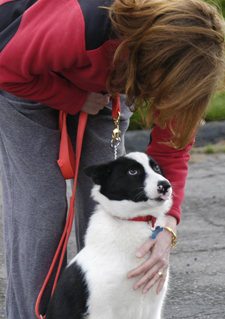
Puppy Training

By Bill Bates
Trainer for California Karelians

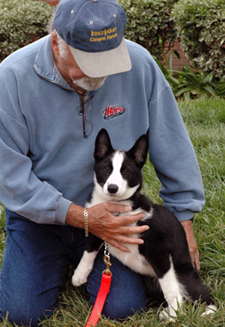
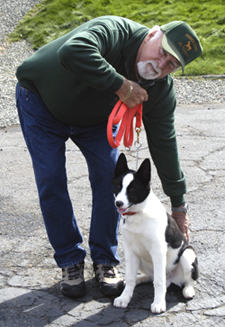
Although formal obedience training should not start until your puppy is at least six months old, a lot of behavioral traits and habits can be taught in an informal manner, which will make formal training easier. Spend as much time as you can with your puppy, and take it with you as much as possible.

You will quickly learn just how well KBD puppies respond to praise. Praise your puppy for everything he/she does right, even if they exhibit the desired behavior for just a moment. At this stage, it’s about working together and forming that bond of mutual trust.

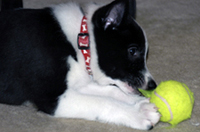
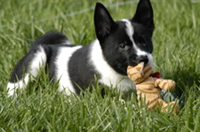
Games can be an important part of the early bonding process. You can create many hours of playtime with a piece of faux fur or a tennis ball. To help lay the foundation for later, more formal training, interact with your puppy as he/she plays. Praise the puppy for showing the slightest interest in a toy. Once the puppy has the toy in his/her mouth, grab on and gently move the toy right and left (never tug forward) to encourage more play. When playtime is over, put away the toys, so the puppy will associate the toys with the act of playing. You may very well find that your puppy will make a toy out of household items just laying around. If your puppy finds a new toy, be sure to praise his/her ingenuity!

Want to start some elementary training? Gently show your puppy what you want while simultaneously using your verbal command. At this stage, keep it simple and make a game of it. If your puppy spontaneously lies down beside you for a tummy rub, say "good laydown" in a very enthusiastic voice while gently stroking the puppy's tummy.

Three Training Phases

Before 6 months of age

The first, and most important, training phase occurs during the first six months. During this time you don’t want to make mistakes by being too harsh or expecting too much. The term “training scars” characterizes a negative response developed in a dog as a result of the being exposed to overly demanding handling or harsh corrections. While training scares can be overcome, these behavioral problems can be avoided and the training experience can be faster and more enjoyable. [more]

Formal obedience training

The second phase starts when you start formal obedience training. Once again, training scars should be avoided. As you work with your dog, realize that all dogs of the same breed are not the same. Each has it’s own personality and will respond differently to correction.

Field Work

The third phase, which I call field work, should only commence once the puppy has successfully learned the basic obedience skills. This may include an activity such as agility or search and rescue.

[more] [back] [more on Obedience ]


© 2007 California Karelians
858.883.9696 San Diego, California