Search & Rescue: Getting Started
 By Madde & Rob Watts By Madde & Rob Watts
Search dog training in the United States has come a long way since Bill and Jean Sytrotuck trained the first dogs in the early 1960’s. Then, there were only a handful of trainers and little knowledge. Studies had been done and papers written on canine nose physiology and scent discrimination, but individual handlers often struggled, continually adjusting their training methods to find what worked best for their dogs. As the number of dog organizations grew, so did the number of opinions on the best method to train a search dog. Yet with training success, the credibility of the search dog grew among the nation’s law enforcement and search and rescue (SAR) organizations.
Today all agree that the ultimate training goal is to have a qualified search team (dog and handler) in the field that meets the requirements of the member SAR organization. As a search dog handler, it is up to you to reach that goal. You alone must decide what works best for you and your dog. Search and Rescue is real work that saves lives. Certification should not be another “shingle” to hang on the K-9 training wall. As a SAR dog handler and search and rescue team member, you will not only be required to be a dog trainer, but to acquire a strong foundation of search and rescue skills and experience yourself. You will be required to meet the standards and skill proficiency of the SAR unit or agency to which you belong. We highly recommend that you contact your county’s Sheriff’s Department to find out where the local Search and Rescue unit meets and what SAR Dog organizations are in your area.
 Required Proficiencies Required Proficiencies
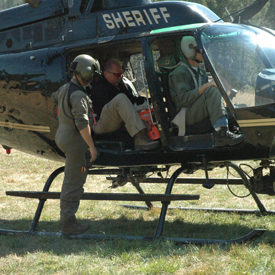
The following are generally considered the minimum required skills you and your dog will need to safely and effectively perform search and rescue. Right, California Karelians' Kandy is hot loading into a helicopter as part of her SAR training:
K-9 skills:
Handler skills:
-
Logbook- documenting training
-
Physical Fitness
-
First Aid
-
CPR
-
Radio Communications
-
Land Navigation: Map/Compass/GPS
-
Rope Skills
-
Low Angle Skills
-
Mantracking
-
Knowledge of Scent
-
Helicopter Safety Class
-
Knowledge of SEMS/ICS: Standard Emergency Management Systems
-
Survival Skills
There are five basic search dog disciplines: wilderness/urban, disaster, avalanche, water, and cadaver. Wilderness/Urban includes area searching (air scenting) as well as trailing (scent discriminating). Most dog teams begin their training in wilderness/urban searching, become mission ready, and move into the other disciplines, thereby building a good foundation from which dog and handler can progress into other disciplines.
Choosing a Search Dog
Choosing the right dog may be the single most important training decision you make. From our experience, we have found that many of the most trainable and successful search dogs have come from a good “ line” and started their training as pups. Breeding predisposed them to the rigors of search work and, as puppies, they were imprinted with SAR training at the earliest possible age. Starting with a dog that has a known background (and developmental history) will greatly enhance your chances of reaching the final training goal: a qualified search dog in the field that is healthy, sound, and has a long service life ahead of it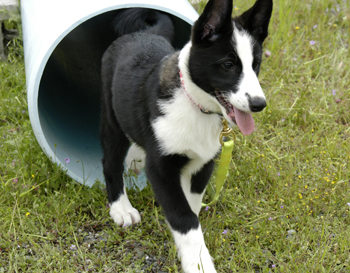 . .
We also believe that a dog must be judged on its own merit and enthusiasm for doing search work. Today, if you poll the nation’s K-9 SAR units, you will find an impressive cross section of canine breeds represented. Of those breeds, a large percentage come from the Working, Herding and Sporting groups. If you are undecided on which breed may be best for you, don’t rush your decision. Contact your local K-9 SAR group and ask if you can attend some of their dog trainings as an observer. This will give you an opportunity to view the different breeds, see their personalities, observe how they work and interact with their owners and other dogs. However, stay away from anyone who says (and believes) that theirs is the only breed suitable for K-9 search work. While there is a natural tendency towards breed loyalty, it is important to keep an open mind. We have seen many breeds be very strong and successful working SAR Dogs.
There are numerous factors that may affect your choice of breed. Here are a few to consider:
-
Temperate zone and climate you live in
-
Type of hair coat and grooming required
-
Size and weight
-
Compatibility of handler and dog personality
-
Will it be an indoor/outdoor dog
-
Male versus female
In Susan Bulanda’s book, Ready! The Training of a Search and Rescue Dog, she identifies seven qualities to look for in a perspective dog:
-
Calm, bold and confident, not aggressive or overly dominant. Any form of aggression towards people or other dogs is an automatic disqualifier for most search dog organizations. That is why it is so important to know the history of your dog and how it has been socialized.
-
People motivated and eager to please. Dogs that are overly independent often prove to be unreliable searchers, because they lack that intense bond between dog and handler that keeps them working.
-
Prefers using his nose rather than making a visual find. You can test your dog for this by hiding his favorite toy outside in the dark and see how eagerly he looks for it. Is he visibly using his nose to find it, or does he lose interest quickly and stop looking?
-
Curious in situations or about new objects. Unduly shy dogs don’t make good search dogs. They tend not to range far from the handlers and show little interest in new experiences.
-
Has the size and build to handle all types of obstacles in both the city and wilderness. Generally, mid-sized dogs from the Working breeds are best suited to this work.
-
Is young and healthy enough to give years of service. The average working dog’s abilities begin to decline at around seven years of age. A dog’s health is paramount in his ability to perform. Your vet should give him a clean bill of health.
-
Has a strong play (or prey) drive. Without it, a dog usually does not prove suitable for search work. He will not have the drive or focus to stay on task.
Evaluating a dog’s temperament, or behavioral characteristics, is also important in determining an individual dog’s suitability to perform a specific task or function such as SAR work. A dog’s temperament is the sum of the natural genetics and behaviors the dog was born with plus the environmental experiences the dog encountered during the critical months of early development. You will be working with your dog to build a team based on trust and a love for the work. Ultimately it will come down to the “size of the dog’s heart” and undying bond to you as handler that will keep the dog working under the worst of conditions. [back]
More Information
Rob and Madde both have extensive backgrounds in search and rescue work. Madde and Rob Watts produced and authored, Search Dog Training: How to Get Started, the first canine training DVD or video to effectively address the numerous aspects that a beginning handler should consider before attempting search dog training, including choosing and evaluating a dog for search work. Filmed with real search dogs in training, it demonstrates the basics of beginning wilderness searching using proven, step-by-step training exercises. This training resource is highly recommended for all beginning search dog handlers and makes a perfect addition to a search and rescue unit's training library. Included are a 44-page manual and a sample training log. (DVD or VHS format, 34 minutes.) If you are interested in purchasing this training guide, a product search for "Search Dog Training" on any of the following websites should take you to the product: National Association for Search and Rescue; Search Gear; or Dogwise.
[more ] [back] ] [back] |


